What bacteriostatic water is
"Bacteriostatic Water for Injection, USP" is a regulated pharmaceutical product. The label on DailyMed (the National Library of Medicine's database of FDA-submitted labels) describes it as a sterile, nonpyrogenic preparation of water for injection containing 0.9% (9 mg/mL) or 1.1% (11 mg/mL) benzyl alcohol as a bacteriostatic preservative.
Its stated purpose is narrow: it is "indicated only for diluting or dissolving drugs" for injection, according to the instructions of the drug's manufacturer. It is a vehicle, not an active ingredient. In research settings the same logic applies: it's the liquid a lyophilized powder is dissolved into.
The word bacteriostatic matters. It means the preservative inhibits bacterial growth after the vial is entered. It doesn't sterilize anything added to it and doesn't make a contaminated preparation safe. That's why the product is supplied in a multiple-dose container and why opened vials still have a discard date.
What the label says (DailyMed)
| Label item | What it says |
|---|---|
| Composition | Water for injection + benzyl alcohol 0.9% (9 mg/mL) or 1.1% (11 mg/mL) |
| Container | Multiple-dose vials (30 mL plastic, 9 mg/mL; 20 mL fill in 30 mL glass, 11 mg/mL); repeated withdrawals permitted |
| Unopened storage | 20–25 °C (68–77 °F) |
| pH | 5.7 (range 4.5–7.0) |
| Header warning | NOT FOR USE IN NEONATES (benzyl alcohol toxicity) |
| Not for | Fluid replacement; epidural or spinal anesthesia procedures |
| Tonicity | Must be made approximately isotonic before use; IV use without a solute may cause hemolysis |
| Inspection | Inspect reconstituted solutions for clarity and freedom from unexpected precipitation or discoloration |
| Status | Marked "Rx only" on this label |
Labels from other manufacturers and repackagers on DailyMed carry the same core statements. Always read the label on the vial you actually have.
Bacteriostatic water vs sterile water
| Bacteriostatic Water for Injection | Sterile Water for Injection | |
|---|---|---|
| Preservative | Benzyl alcohol 0.9% | None |
| Container | Multiple-dose | Typically single-dose |
| After first entry | Date it; discard within 28 days unless the manufacturer says otherwise | Use once, discard the remainder |
| Neonates | Not for use | The label's stated choice for neonatal preparations (preservative-free) |
For lab reconstitution of a vial that will be drawn from repeatedly, bacteriostatic water is the common choice because of the preservative. Some peptides have specific solvent requirements (very hydrophobic sequences, for example). Peptide manufacturers such as Bachem note there's no universal dissolving protocol and that solubility depends on the sequence. Follow the compound's own documentation when it has any.
What the benzyl alcohol does
Benzyl alcohol is the only ingredient besides water. At 0.9% (9 mg in every mL) it acts as a preservative: it suppresses the growth of bacteria that could get in when a needle passes through the stopper. That's the whole reason this product exists in a multiple-dose format. Sterile Water for Injection has no preservative, so once its seal is broken there's nothing to slow contamination, which is why it's supplied for single use.
The same preservative is the reason for the label's main warning. Benzyl alcohol has been associated with toxicity in neonates, so the label says that where water is needed to prepare medicines for newborns, only preservative-free Sterile Water for Injection should be used. It also explains why the label rules out large volumes (fluid replacement) and epidural or spinal procedures.
For lab arithmetic the preservative changes nothing. It doesn't add mass that matters to the concentration calculation, and 1 mL of bacteriostatic water is treated as 1 mL of diluent.
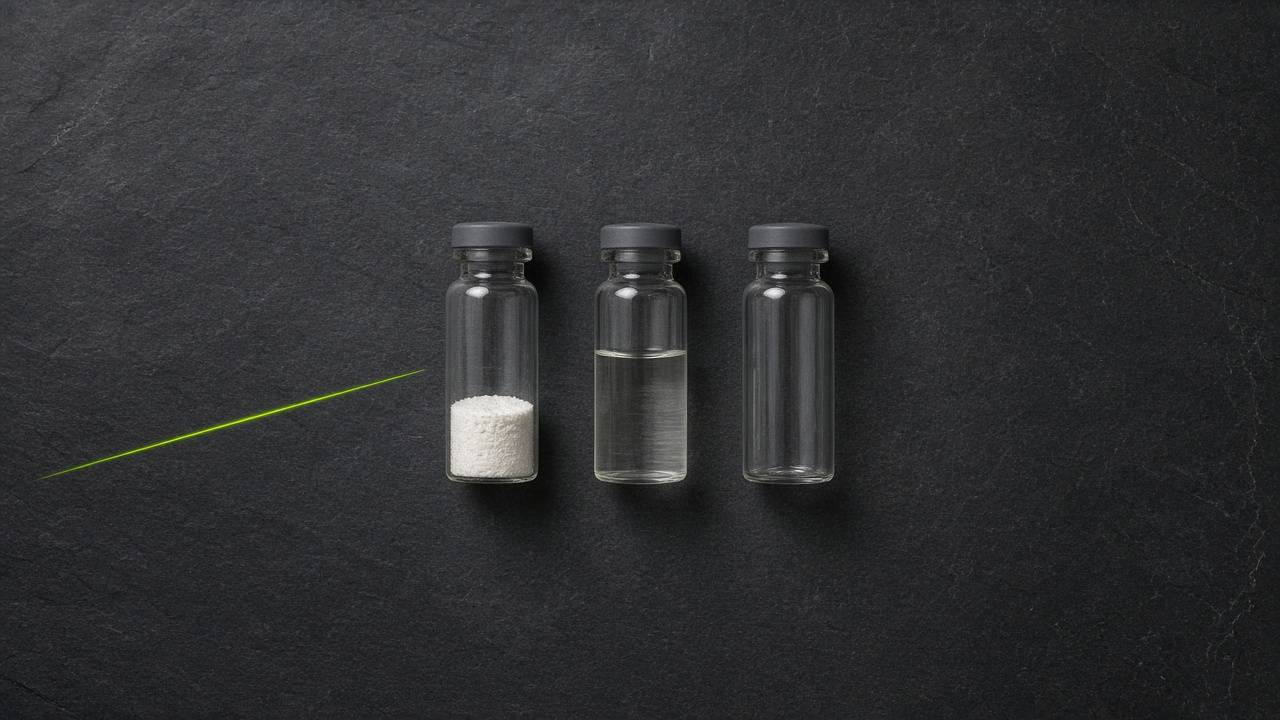
How far one 30 mL vial goes
A 30 mL multiple-dose vial is the size on the label we cite. How many peptide vials it can reconstitute is simple division, but the 28-day rule usually matters more than the volume:
| Water per peptide vial | Peptide vials per 30 mL |
|---|---|
| 1 mL | 30 |
| 1.5 mL | 20 |
| 2 mL | 15 |
| 2.5 mL | 12 |
| 3 mL | 10 |
| 5 mL | 6 |
In practice, each entry also loses a little volume to the needle and the syringe's dead space, and an opened vial is dated and discarded on the CDC schedule regardless of how much is left. Plan around the date, not the volume.
Handling the diluent vial
CDC's injection-safety guidance for multi-dose vials is written for clinical settings, but the same aseptic principles apply in any lab:
- Swab the stopper with alcohol and let it dry before each puncture.
- Use a new sterile needle and syringe every time the vial is entered. Never re-enter with a used one.
- Never leave a needle in the stopper between uses. It's an open path for contamination.
- Date it on first puncture and follow the 28-day rule (below).
- Inspect it before each use. Cloudiness, particles or a damaged seal mean discard.
How long bacteriostatic water lasts after opening
CDC's injection-safety guidance for multi-dose vials is the clearest public rule:
- Once a multi-dose vial is opened or punctured, date it.
- Discard it within 28 days unless the manufacturer specifies a different (shorter or longer) date for the opened vial.
- The beyond-use date should never exceed the manufacturer's original expiration date.
- Discard immediately if sterility is compromised or in question.
Unopened vials follow the expiration date printed on the vial. That 28-day rule is about the diluent vial itself. How long a reconstituted peptide stays stable is a separate question that depends on the peptide. See the storage guide.
How much bacteriostatic water to add
The volume isn't set by the water; it's set by the arithmetic you want. The total milligrams in the vial never change. The water only decides how many milliliters they're spread across:
For a 10 mg vial and a 1 mg reference amount, here is what each volume does to the syringe reading:
| Water added | mg/mL | mcg per unit | Units for 1 mg | Smallest U-100 barrel |
|---|---|---|---|---|
| 1 mL | 10 | 100 | 10 | 30-unit |
| 2 mL | 5 | 50 | 20 | 30-unit |
| 2.5 mL | 4 | 40 | 25 | 30-unit |
| 3 mL | 3.33 | 33.33 | 30 | 30-unit |
| 4 mL | 2.5 | 25 | 40 | 50-unit |
| 5 mL | 2 | 20 | 50 | 50-unit |
Three practical rules:
- Readability. Small amounts are easier to measure when they take more units, which means more water.
- Capacity. Large amounts need to fit one barrel: a 30-unit (0.3 mL) barrel can't hold 40 units. Less water keeps readings smaller.
- Round numbers. Choose a volume that makes one unit a round figure (2 mL in a 10 mg vial gives 50 mcg per unit) so results are easy to double-check by hand.
To work backwards from a reading you want, use the bacteriostatic water calculator. To convert any amount once you've chosen, use the peptide calculator.
Frequently asked questions
What is bacteriostatic water?
Bacteriostatic Water for Injection, USP is sterile, nonpyrogenic water for injection with 0.9% benzyl alcohol (9 mg/mL) added as a preservative. The preservative suppresses bacterial growth, which is why it is supplied in multiple-dose vials that can be entered more than once.
What is the difference between bacteriostatic water and sterile water?
Both are sterile water for injection. Bacteriostatic water contains benzyl alcohol as a preservative and comes in multiple-dose vials. Sterile Water for Injection has no preservative, is typically a single-dose container and is meant to be used once and discarded.
How long does bacteriostatic water last after opening?
CDC guidance for multi-dose vials is to date the vial when first opened or punctured and discard it within 28 days, unless the manufacturer specifies a different date, and never past the printed expiration date. Discard it sooner if sterility is in question.
Is bacteriostatic water safe for everyone?
No. The DailyMed label is headed "WARNING: NOT FOR USE IN NEONATES", because benzyl alcohol has been associated with toxicity in newborns. The label also says it should not be used for fluid replacement or in epidural or spinal procedures.
How much bacteriostatic water do I add to a peptide vial?
There is no fixed amount; the volume sets the concentration. 10 mg in 1 mL is 10 mg/mL, in 2 mL is 5 mg/mL, in 3 mL is about 3.33 mg/mL. Use the BAC water calculator to pick a volume that makes your amount land on a readable syringe mark.
Does bacteriostatic water sterilize what it is mixed with?
No. "Bacteriostatic" means it inhibits bacterial growth; it does not kill all microorganisms or make a non-sterile preparation sterile. Aseptic technique still matters.
How many peptide vials can one 30 mL vial of bacteriostatic water reconstitute?
By volume alone, 30 mL ÷ 2 mL = 15 vials, or 10 vials at 3 mL each. In practice the 28-day discard rule for opened multi-dose vials, and small losses on each entry, usually limit it first.
Can I reuse a needle to draw from the bacteriostatic water vial?
No. CDC guidance is to use a new sterile needle and syringe every time a multi-dose vial is entered, and never to leave a needle in the stopper.
What pH is bacteriostatic water?
The DailyMed label lists pH 5.7, with a range of 4.5 to 7.0.
Sources
- Bacteriostatic Water for Injection, USP (Hospira) — prescribing label
- Preventing Unsafe Injection Practices (multi-dose vial beyond-use dating)
- FDA alerts health care providers, compounders and patients of dosing errors associated with compounded injectable semaglutide products
- Handling and Storage Guidelines for Peptides
Links checked 2026-10-19.