The math in three lines
2. volume (mL) = amount (mg) ÷ concentration
3. units (U-100) = volume (mL) × 100
That's the whole thing. Reconstitution is a dilution: a fixed mass of solid spread through a volume of liquid you choose. Everything downstream (mL, syringe units, number of draws from a vial) follows from the concentration. That's why the concentration belongs on the label, and why a units figure copied from somewhere else is meaningless unless the vial size and water volume match yours exactly.
The calculator below does all three steps, shows the syringe fill and keeps the result in a shareable link.
Reconstitution calculator
Result
units
to draw on a U-100 syringe, 100-unit barrel
- Volume
- 0.4 mL
- Concentration
- 5 mg/mL
- Per unit
- 50 mcg
- Draws per vial
- 5
10 mg + 2 mL = 5 mg/mL, so 2 mg is 0.4 mL, or 40 units on a U-100 syringe.
Arithmetic only. Not a dosing recommendation. Check every figure against your vial label and lab protocol.
Materials
- The lyophilized vial, with its labeled total content in mg.
- Diluent, typically bacteriostatic water (0.9% benzyl alcohol, multiple-dose) unless the compound's documentation specifies another solvent.
- A sterile syringe sized for the diluent volume. Measuring 2 mL is easier on a 3 mL syringe than on several fills of a 1 mL insulin syringe.
- Alcohol swabs for the rubber stoppers.
- A label or marker, and somewhere to write the numbers before you start.
Lab steps
- Do the arithmetic first. Decide the water volume and write down the resulting concentration and what one unit holds. Changing your mind after the water is in means recalculating everything.
- Let the vial reach room temperature, closed. Peptides tend to be hygroscopic. Bachem recommends letting the container warm (ideally in a desiccator) before opening so moisture does not condense on the powder.
- Work clean. Clean hands or gloves and a clean surface. Remove the flip-off caps and swab both rubber stoppers with alcohol; let them dry.
- Measure the diluent. Draw the planned volume of bacteriostatic water. Check the barrel at eye level; an air bubble inflates the reading.
- Add it slowly down the inside wall. Angle the needle so the liquid runs down the glass rather than jetting onto the powder. Some vials are sealed under partial vacuum and will draw the liquid in by themselves; let it flow at its own pace.
- Swirl, don't shake. Roll or swirl gently and let it stand. Most lyophilized peptides dissolve within a few minutes; some take longer. Shaking foams the solution and can promote aggregation.
- Inspect. The bacteriostatic water label instructs checking reconstituted solutions for clarity and freedom from unexpected precipitation or discoloration. Cloudy or particulate solutions are discarded.
- Label it. Compound, total mg, mL added, mg/mL, what one unit contains, and the date. See the label template.
- Store it. In solution, peptides are much less stable than as powder. See the storage guide.
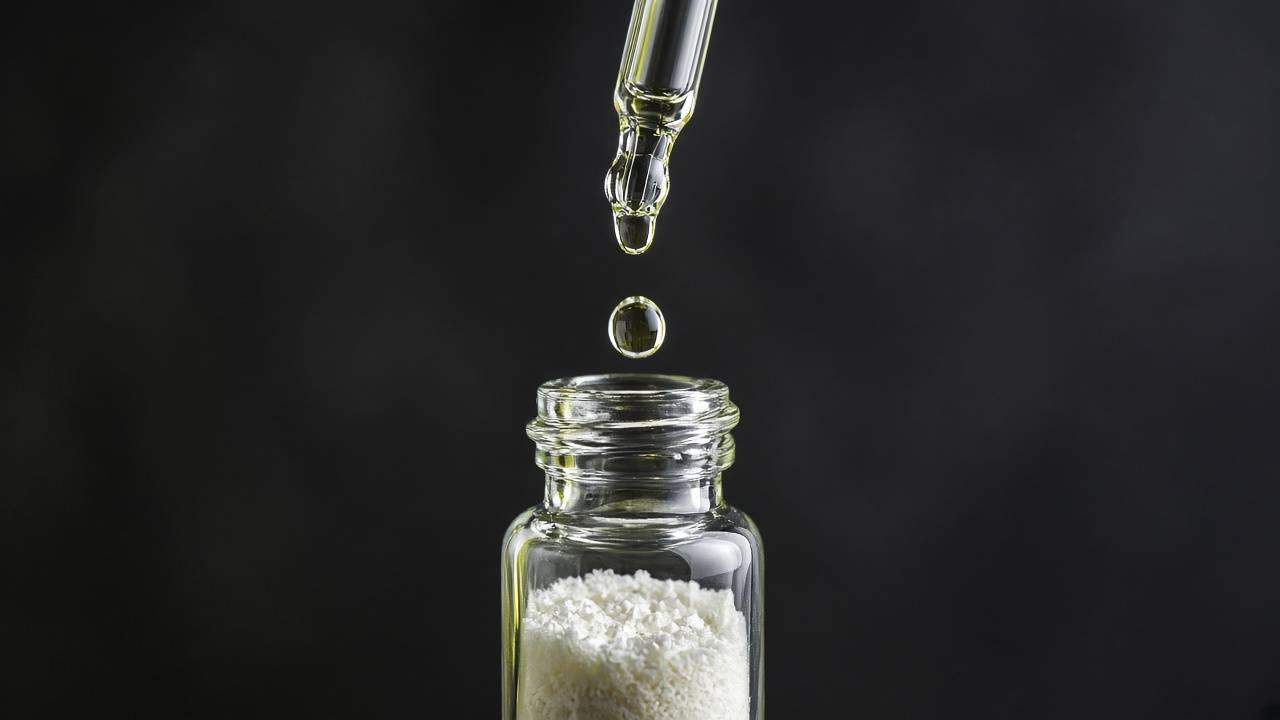
How much water should you add?
There's no "correct" volume. There's a volume that makes your numbers convenient. Three forces pull in different directions:
- Resolution. More water spreads the same mg over more units, so a small amount takes more marks and is easier to set accurately. 250 mcg from a 5 mg vial is 5 units at 1 mL but 10 units at 2 mL.
- Capacity. Less water keeps large amounts inside one barrel. 5 mg from a 10 mg vial is 100 units at 2 mL, a full 1 mL syringe, but 50 units at 1 mL.
- Round numbers. Pick a volume that makes "one unit" a round figure. 10 mg in 2 mL = 0.05 mg (50 mcg) per unit; 10 mg in 2.5 mL = 0.04 mg per unit. Round figures are easy to check by hand.
The bacteriostatic water calculator runs this in reverse: give it the reading you want and it returns the volume. The matrix below shows what one unit holds for common vial sizes and volumes:
| Vial | 1 mL | 2 mL | 2.5 mL | 3 mL | 5 mL |
|---|---|---|---|---|---|
| 2 mg | 20 (2) | 10 (1) | 8 (0.8) | 6.67 (0.667) | 4 (0.4) |
| 5 mg | 50 (5) | 25 (2.5) | 20 (2) | 16.67 (1.67) | 10 (1) |
| 10 mg | 100 (10) | 50 (5) | 40 (4) | 33.33 (3.33) | 20 (2) |
| 15 mg | 150 (15) | 75 (7.5) | 60 (6) | 50 (5) | 30 (3) |
| 20 mg | 200 (20) | 100 (10) | 80 (8) | 66.67 (6.67) | 40 (4) |
| 30 mg | 300 (30) | 150 (15) | 120 (12) | 100 (10) | 60 (6) |
Worked examples
| Vial | Water | mg/mL | Amount | mL | Units |
|---|---|---|---|---|---|
| 5 mg | 2 mL | 2.5 | 0.25 mg | 0.1 | 10 |
| 10 mg | 2 mL | 5 | 2 mg | 0.4 | 40 |
| 10 mg | 3 mL | 3.33 | 1 mg | 0.3 | 30 |
| 15 mg | 3 mL | 5 | 2.5 mg | 0.5 | 50 |
| 30 mg | 3 mL | 10 | 5 mg | 0.5 | 50 |
Read the second row as a sentence: 10 mg + 2 mL = 5 mg/mL, so 2 mg is 0.4 mL, or 40 units on a U-100 syringe. Every calculator on this site states its answer in that form.
Label template
DILUENT ____ mL bacteriostatic water
CONC ____ mg/mL 1 UNIT = ____ mg
RECONSTITUTED ____/____/____
The "1 unit =" line is the one people skip and later wish they had. It turns every future reading into one multiplication.
What causes tenfold errors?
- mg vs mcg. A 1,000× error. 250 mcg is 0.25 mg. See mcg to mg.
- Units vs mL. A 100× error on U-100. 10 units is 0.1 mL, not 10 mL or 1 mL.
- 5 vs 50. FDA's 2024 alert on compounded semaglutide described people told to draw 5 units who drew 50 instead.
- Copied units from a different vial. 40 units means 2 mg from a 10 mg / 2 mL vial but 8 mg from a 40 mg / 2 mL vial.
- Wrong syringe scale. U-40 barrels read 2.5× larger volumes for the same number. See syringe units.
- Losing the concentration. If the vial isn't labeled, nobody can redo the math later.
Reconstitution by compound
- How to reconstitute Retatrutide (5, 10, 12, 15, 20, 24, 30, 40 mg vials)
- How to reconstitute Tirzepatide (5, 10, 15, 30, 60 mg vials)
- How to reconstitute Semaglutide (2, 5, 10, 20 mg vials)
Frequently asked questions
What does reconstitute mean?
To reconstitute a lyophilized (freeze-dried) peptide is to dissolve the powder in a measured volume of liquid, usually bacteriostatic water, so that it becomes a solution of known concentration.
How do you calculate peptide reconstitution?
Divide the vial contents by the water added to get the concentration: 10 mg ÷ 2 mL = 5 mg/mL. Then divide any amount by the concentration for the volume (2 mg ÷ 5 mg/mL = 0.4 mL) and multiply by 100 for U-100 syringe units (40 units).
Should I shake the vial after adding water?
No. General peptide-handling practice is to swirl or roll gently and let the vial stand until the powder dissolves. Vigorous shaking can foam the solution and may promote aggregation of some peptides.
Does adding more water change how much peptide is in the vial?
No. The total mg is fixed by the vial. More water lowers the concentration, so each unit on the syringe holds less, and the same amount takes more units.
What if the powder does not dissolve?
Give it time at room temperature and swirl gently. Some sequences are poorly soluble in water; peptide manufacturers note that solubility depends on the sequence and that hydrophobic peptides may need a different solvent. Do not use a solution with visible particles or cloudiness.
What should go on the label of a reconstituted vial?
At minimum: compound, total mg, the volume of diluent added, the resulting concentration in mg/mL, what one syringe unit contains, and the date reconstituted. The concentration is the figure every later calculation depends on.
Sources
- Handling and Storage Guidelines for Peptides
- Bacteriostatic Water for Injection, USP (Hospira) — prescribing label
- Preventing Unsafe Injection Practices (multi-dose vial beyond-use dating)
- FDA alerts health care providers, compounders and patients of dosing errors associated with compounded injectable semaglutide products
Links checked 2026-10-19.